

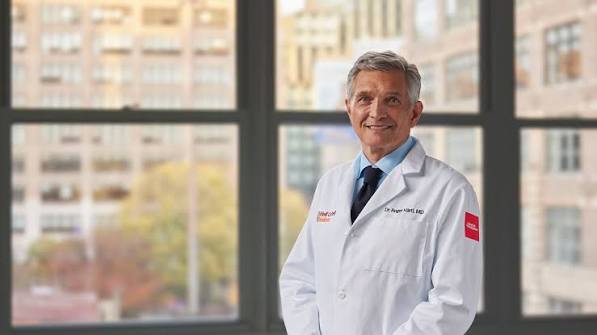
Weill Cornell Medicine’s Department of Neurological Surgery is proud to share that Roger Härtl, MD has been named one of twenty surgeons to know by Becker’s Spine Review, a recognition that reflects not just his skill as a clinician, but the scope of what he has built in research and innovation outside of the operating room.
Dr. Härtl is director of spinal surgery at the Weill Cornell Medicine Brain and Spine Center and co-director of NewYork-Presbyterian Och Spine. He specializes in complex spine surgery for degenerative conditions, tumors and trauma and is a pioneer in minimally invasive spine surgery and computer-assisted navigation. He has authored more than 300 peer-reviewed articles, with research spanning biological disc repair and regeneration and augmented reality and navigation in spine surgery. He also leads Weill Cornell Medicine's Global Neurosurgery Initiative in Tanzania and was named the American Association of Neurological Surgeons' 2022 Humanitarian of the Year.
Setting the Standard for "Minimally Invasive"
"Minimally invasive spine surgery" is a phrase patients hear constantly, but it has never had a concrete definition, which makes it nearly impossible to compare one surgeon's approach to another's. Dr. Härtl is helping to close that gap. In a study published in Global Spine Journal, he and an international panel of 45 spine surgeons introduced the Minimally Invasive Spine Surgery Invasiveness Classification, known as MISS-INC (L), the first consensus-based scoring system for quantifying invasiveness in degenerative lumbar spine procedures. After a three-year modified Delphi process, the panel landed on nine measurable factors, from operative time to muscle dissection to fusion technique, each scored to produce a total invasiveness score. As Dr. Härtl put it, "The main benefit is that you can actually quantify invasiveness now. Now we can compare invasiveness — before, you couldn't do that."
Challenging the Multilevel Fusion Standard
For decades, the accepted teaching in spine surgery has been that if one level needs a fusion and a neighboring level is also a problem, you fuse them both. A new study led by Dr. Härtl, published in the Journal of Neurosurgery: Spine, questions that assumption. His team's "one-and-a-half level" technique fuses only the truly unstable level while decompressing, but not fusing, the adjacent narrowed one. Looking back at 33 patients treated between 2016 and 2023, the results held up: 96 percent achieved fusion, only three patients needed a second surgery and there were no neurological complications. The takeaway, in his words: "It's not a rare problem. It's one of the most common surgeries we do... nobody seems to really try to figure out how new technology can be used to minimize the need for fusion."
Pioneering Soft-Tissue Robotic Spine Surgery
This summer, Dr. Härtl and colleagues Ibrahim Hussain, MD and Justiss Kallos, MD performed the East Coast's first soft-tissue robotic spine tumor surgeries, completing three cases using the Symani Surgical System, including the world's first robotic resection of a cervical spine tumor. Unlike the "hard-tissue" robots that help guide screws into bone, this system is closer in concept to the da Vinci platform used in abdominal surgery, built to a scale small enough for the delicate work of the spine. Operating from a console feet away from the patient, Dr. Härtl described the experience as "a glimpse of what's going to come in the future." His team is now working to combine the technology with 3D navigation and augmented reality for minimally invasive spine surgery more broadly.
A 2026 Ellis Island Medal of Honor Recipient
Dr. Härtl was also selected to receive the 2026 Ellis Island Medal of Honor, one of the country's most prestigious civilian awards, recognizing individuals whose work reflects lasting contributions to society. For Dr. Härtl, who immigrated to the United States as a young physician, the honor carries personal as well as professional weight. It also recognizes the Tanzania Neurosurgery Project he has led since 2008, which has helped grow the country's neurosurgical workforce from three surgeons serving roughly 40 million people to more than 25 today. "We learned over time that real impact comes from teaching, training and building local systems that continue to grow independently," Dr. Härtl explained.
Recognition Well Earned
From redefining how the field measures invasiveness, to challenging decades of surgical teaching, to bringing entirely new robotic technology to patients on the East Coast, to being honored for a legacy of global service, Dr. Härtl's work this year captures exactly why he's being named one of twenty surgeons to know. Congratulations, Dr. Härtl, on this well-deserved recognition.