

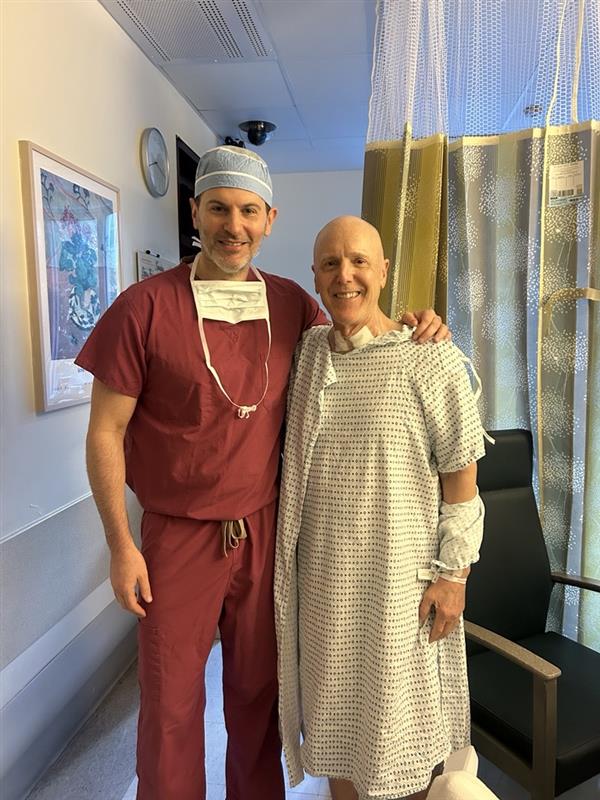
Weill Cornell Medicine's Department of Neurological Surgery, in collaboration with the Department of Neurology, has completed the first implantation of a carotid filter in New York State as part of the INTERCEPT trial — a multi-center, international, randomized study evaluating a novel approach to stroke prevention in patients with atrial fibrillation.
About the INTERCEPT Trial
Atrial fibrillation, a common heart arrhythmia, puts patients at elevated risk for stroke by allowing blood clots to form in the heart's left atrium. Blood-thinning medications have significantly reduced the chance of stroke for patients with atrial fibrillation, but there is still a risk.
The INTERCEPT trial tests whether implanting a carotid filter in addition to standard blood thinner therapy can provide an additional layer of protection. The device — a helical coil placed in the common carotid artery — is designed to catch any clots that form in the heart and travel toward the brain, trapping them before they can block blood flow. Blood continues to circulate past the clot through the large artery, and the clot dissolves over time with the help of blood thinners.
The trial plans to enroll approximately 2,000 patients worldwide and is now in its Phase 3 stage, having already been tested in roughly 100 patients in earlier studies.
Weill Cornell Medicine neurologist Dr. Hooman Kamel described the significance of the technology: "The idea is that patients who have this heart condition are at risk of blood clots forming in the left atrium. Even though blood thinners reduce this risk, they're not perfect — clots can still form.” Dr. Kamel explained that researchers have long been investigating how to protect this population of patients. Adding these filters to the blood thinner provides more protection, which can potentially reduce the risk of stroke more than just the blood thinners alone.

A Model of Interdepartmental Collaboration
The trial exemplifies the kind of cross-disciplinary partnership that distinguishes Weill Cornell Medicine's approach to neurological care. Neurologists identify and manage patients medically, while neurosurgeons perform the filter implantation.
Dr. Luis Carlos De Carvalho Paixao noted the strength of the collaboration: "We have very good interactions and connections between neurology and neurosurgery. We are also collaborating on other trials — including the STRIDE trial with Dr. J Mocco. It's a very exciting time for neuroscience, and it's great that we have such an amazing relationship between the two departments."
Dr. Jared Knopman, Weill Cornell neurosurgeon and co-investigator on the trial, brings deep experience in endovascular and open carotid procedures to the study. Though the carotid filter is placed slightly lower in the common carotid artery than a typical stent, Dr. Knopman's expertise made the transition seamless.
“The procedure truly defines what minimally invasive means,” Dr. Knopman said. “Through an ultrasound-guided needle stick, we can place the filter directly into the carotid artery under local anesthesia and mild sedation. When the band-aid comes off, the puncture site is practically invisible.”
The Patient's Experience
Stephen Cavallo, the first patient in New York to receive the filter (and the second in the United States), came to Weill Cornell Medicine after suffering a stroke. Thankfully, his stroke was caught quickly, in part due to a sharp-eyed personal trainer who noticed Stephen had a sudden onset facial droop and slurred speech mid-workout and urged him to seek help. He arrived at the hospital two hours later. Stephen was taking clopidogrel, a medication to prevent platelets from sticking together and forming clots, but there was a small clot in a brain artery that caused the stroke.
Already living with atrial fibrillation and a previously implanted Watchman device — another tool used to prevent stroke in AFib patients — Stephen still experienced a stroke, underscoring the limitations of any single line of defense. With the carotid filter now in place alongside his existing device and medication regimen in the form of a blood thinner, he is, as Dr. Kamel put it, "triple protected."
Stephen described his experience in the trial and through surgery as smooth from start to finish. "They talked me through the whole thing, so the surgery was like nothing to me," he said. "I was totally relaxed. And since then, I haven't had any issues at all."
He credited the care team's warmth and transparency with putting him at ease: "They're easy to be with. They made me feel comfortable."
Looking Ahead
With enrollment now underway across international sites, Weill Cornell Medicine is proud to be among the early adopters of this promising technology. The INTERCEPT trial represents not only a potential advancement in stroke prevention, but a testament to what's possible when neurology and neurosurgery work in close collaboration.