

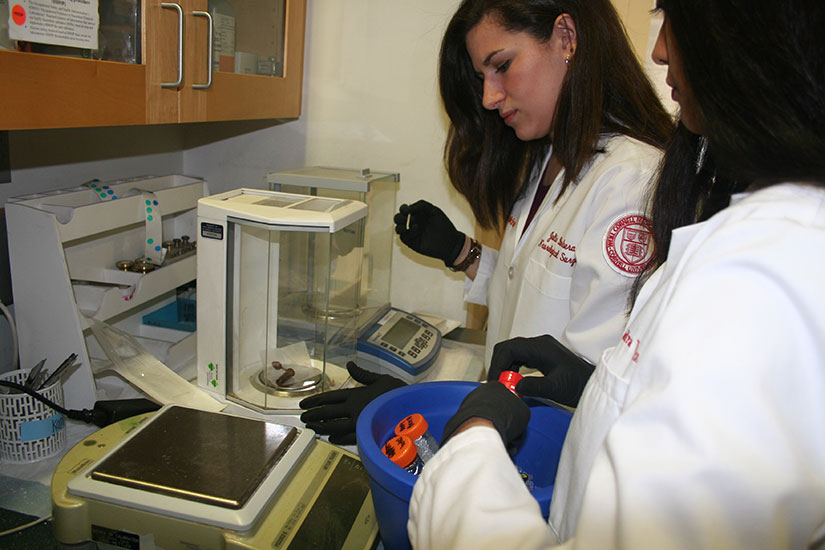
The neurosurgeons, researchers, and physician/scientists of Weill Cornell Medicine are committed to collaboration. Research teams perform bench and translational research, including the infusion of drugs and growth factors with great promise for neurological diseases and the evaluation of every pediatric brain tumor for DNA fingerprints to help guide treatment. We explore new biological stem cell technology for the treatment of neurological disorders including stroke and brain tumors as well as gene therapy for Parkinson's disease and other movement disorders.
Our neurosurgical research laboratories include the:
- The Hollis Lab, directed by Dr. Edmund Hollis, which studies how the brain and spinal cord respond to injury and how movement is recovered, including a clinical program focused on peripheral nerve regeneration.
- Molecular Neurosurgery Research Lab, directed by Dr. Michael Kaplitt, which facilitates a better understanding of why brain cells die as a result of neurodegenerative disorders such as Parkinson's disease.
- Pediatric Neuro-oncology Research Labs, directed by Drs. Mark Souweidane and Jeffrey Greenfield, which facilitate innovative delivery of therapeutic agents, genomic sequencing and neovascularization studies.
- Biological Spine Tissue Research Lab, co-directed by Drs. Roger Härtl and Ibrahim Hussain. Collaboration with the Bonassar Lab at Cornell University Dept. of Biomedical Engineering. Focused on the development of biological disc replacement, annular repair using high-density collagen gels, and stem-cell augmented therapies with in vivo testing in small and large animal models, histologic anaylsis, cell culturing biomechncail testing and FDA IDE studies.
- Neural Circuits and Analgesia Research Lab, directed by Dr. Nicole Mercer Lindsay, which investigates brain circuits underlying pain and movement to identify new targets for therapeutic brain stimulation and chronic pain treatment.
- Basic Neurosurgery Research Lab, directed by Dr. Nadia Dahmane, in which the mechanism controlling brain development and its deregulation in brain tumors, as well as interactions between the immune system and brain tumors, are studied.
- The Asuzu Lab, directed by Dr. David Asuzu, focuses on epigenetic and transcriptomic drivers of tumor invasion, including brain and spine tumors. The lab also researches molecular drivers of spine degeneration due to spine stem cell aging.
- The Brain Tumor Translational Science Research Lab, directed by Dr. Dominique Higgins, uses innovative model systems to translate laboratory discoveries into new therapies for brain tumors, with a focus on metabolism, radiation biology, stem cell biology, immunotherapy and targeted delivery of drug and cell-based therapies.
- Ramakrishna–Dahmane Lab for Brain Tumor Immunoengineering, directed by Dr. Rohan Ramakrishna and Dr. Nadia Dahmane, focuses on developing and advancing cell therapies for CNS tumors from target identification and validation through first-in-human clinical trials testing.
The Surgical Innovations Laboratory
In addition to our laboratory research, surgeons and residents from around the world develop and improve their surgical approaches to the skull base in the WCM Surgical Innovations Laboratory for Skull Base Microneurosurgery, an educational laboratory that facilitates advanced hands-on and virtual training. Surgical Innovations Laboratory